
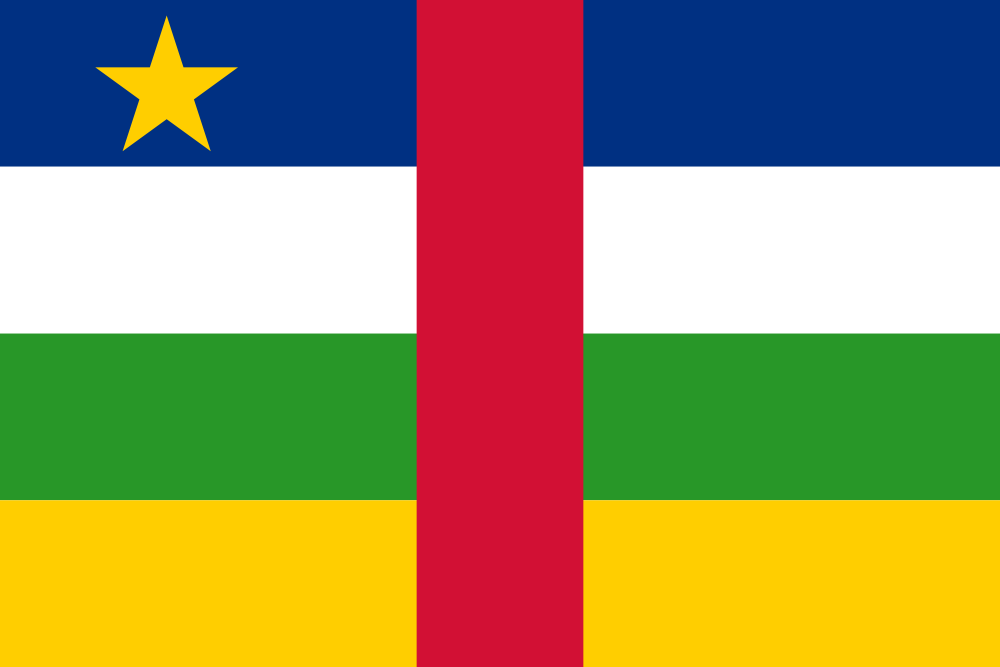
Central African Republic Flag
Price range: R400,00 through R860,00
The Central African Republic flag, available as a full-size flag in 180 x 120cm and 90 x 60cm, or as a desk flag in packs of 10. Digitally printed on both sides onto durable polyester, so the design reads correctly from either side.
Priced from R400, with delivery anywhere in South Africa. Need a custom or branded flag instead? Request a quote.
Lead Time
Please allow 3–5 working days for us to prepare your order before it heads out for delivery. We’ll always try to get it to you sooner where we can.
Description
The Central African Republic flag is available from Flags Online in full-size and desk formats, printed on both sides and made to last outdoors.
About the Central African Republic Flag
Four horizontal bands, blue, white, green and yellow from top to bottom, are cut through by a single vertical red band running down the centre of the Central African Republic flag, with a yellow five-pointed star placed in the upper hoist corner on the blue band. The combination of horizontal and vertical stripes in one flag is unusual and makes this design stand out among African national flags.
Colours and Symbolism
The Central African Republic flag was deliberately built to combine two colour traditions at once. Blue and white echo the colours of France, reflecting the territory’s history as a French colony, while green and yellow are drawn from the wider colour palette used by African independence movements of the period. The central red band is meant to connect the two groups, standing for the shared blood of humanity and the respect that both Europeans and Africans should hold for one another. The yellow star in the corner represents the country’s aspirations toward a better future and is also read as a symbol of African unity and progress.
History of the Central African Republic Flag
The flag was designed by Barthélemy Boganda, the territory’s leading nationalist politician and later its first head of government, and it was adopted on 1 December 1958, when the territory, then known as Ubangi-Shari, became the autonomous Central African Republic within the French Community. Boganda intended the design to express a union between France and Africa rather than a rejection of one for the other, which set it apart from several neighbouring territories that dropped French colours entirely on gaining independence. When full independence was declared in 1960, the flag adopted two years earlier was kept unchanged, and the Central African Republic flag has remained in use, including through the country’s brief period as the Central African Empire between 1976 and 1979.
Flying and Displaying the Flag
The flag is flown at government buildings in Bangui and across the country’s regions, and displayed on national days including Independence Day on 13 August. Reproducing the flag correctly means keeping the vertical red band centred and the star fixed in the blue band’s upper corner rather than free-floating, since both elements are part of the official specification.
Central African Republic Flag Sizes and Pricing
- 180 x 120cm — R860
- 22 x 15cm Desk Flag (10 units) — R800
- 10 x 15cm Desk Flag (10 units) — R650
- 90 x 60cm — R400
Material and Construction
Made from 100% polyester bunting material and digitally printed on both sides. Hemmed all around with two rows of stitching and finished with a polyester webbing heading. Rope and toggle for hoisting included.
Supplied in packs of 10. Printed on both sides onto polyester and supplied with a black plastic stick and removable base — take the base off and it doubles as a hand waving flag.
Ordering and Delivery
Every Central African Republic flag is printed to order and dispatched from our Gqeberha (Port Elizabeth) and Johannesburg branches, with courier delivery nationwide. Bulk and school orders are welcome — contact us for volume pricing on quantities of 10 or more.
Order Lead Times
Almost everything we make is freshly printed and made to order, just for you! So please allow 3–5 working days for us to prepare your order before it heads out the door. We’ll always try to get it to you sooner where we can. Some fast movers, like South African flags, ship quicker as they’re often in stock.
One quick thing to keep in mind: the “next working day” you see on your order confirmation is the courier’s delivery time from the day we dispatch — not from the day you place your order. So it’s really 3–5 days to prepare + next-day delivery.
Good things are worth the wait — we’re excited to get your order into your hands.
Additional information
| Weight | N/A |
|---|---|
| Size | 10 x 15cm Desk Flag (10 units), 180 x 120cm, 22 x 15cm Desk Flag (10 units), 90 x 60cm |
Only logged in customers who have purchased this product may leave a review.

Reviews
There are no reviews yet.